Monday, 27 June 2016

#MédocMondays

Regular readers of my blog (a big thanks to both of you!) will know of my affection for the wines of Bordeaux, from the splendour and gloriousness of the Classed Growths to the humble joys and drinkability of basic AC wine. Although the UK's recent decision to pull out of the European Union and subsequent currency fluctuations has effectively put an end to my dabbling in the en primeur market for this year, it hasn't quelled my enjoyment of the region's finished wines currently on sale. As well as good Claret, I'm also a sucker for good offers, so when Sainsbury's ran one of their perennial 25% off 6 wines a few weeks ago, I couldn't bring myself to turn it down. As well as some intriguing little wines that I'd had my eye on for some time (including Sainsbury's Taste the Difference Priorat 2013, which I can't wait to taste) the star buy was one of the supermarket's premium offerings, namely the Château Cambon La Pelouse 2012. Ordinarily retailing at around the £20 mark, I jumped at the chance to try a highly-regarded, young Cru Bourgeois wine for the £15 which I paid.


One of the oldest estates in the Haut-Médoc, the recent history of Château Cambon La Pelouse begins in 1996 when the property was renovated and updated to modern vineyard and winery standards by its current owners. The estate is situated very close to the prized Margaux sub-region of Bordeaux, and its vineyards share the same deep, gravelly soils of its more distinguished neighbours. The 35 hectares of vineyards are planted with Merlot, Cabernet Sauvignon and Petit Verdot, with an average vine age of 30 years. As with the rest of Bordeaux, 2012 wasn't the best ever vintage in the Haut-Médoc, with a cold spring preceding a hot August and September followed by rain during harvest time. Having sampled numerous 2012s, I confirm that this is not a Claret vintage to lay down for decades to come; yet most of the wines I've tried are charming, medium-bodied and easy to approach in their youth. Therefore, with its provenance and premium price tag, I expected good things from the 2012 Pelouse.


In general, the critics were collectively positive about the Estate's 2012 wine. In his ever-reliable book 'The Best Wines in the Supermarkets', writer Ned Halley was glowing in his praise of the Cambon La Pelouse 2011, scoring it 8/10 and commenting: "[...] this is an aspiring claret. You get deep ruby colour already showing a tinge of browning and a rich, coffee-cedar-leather luxury aroma en route to a silky and well-developed plummy-black fruit. [...] it delivers a lot for the premium price". Of the stronger 2012 vintage, Robert Parker gave the wine a score of 87-89, praising the wine's "excellent texture" and commenting on its notes of "cranberries, red and black cherries, forest floor and hints of white chocolate as well as background earth". Decanter magazine also rated the wine highly, calling it "suave and velvety, a modern-style claret with abundant fruit and spice. Powerful and long (17.5/20)". With glowing comments and high scores from a middling vintage, I was eager to sample the wine for myself.
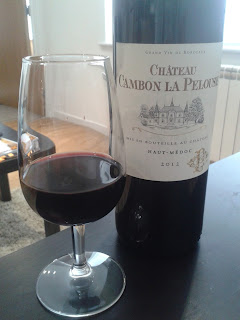


A medium ruby colour in glass, the wine is initially slightly reticent on the nose, with the plum and strawberry notes which creep from the glass being joined by more typical blackcurrant and pencil lead notes with aeration. The palate is medium-bodied and taut, with typical youthful acidity and drying tannins providing a comforting 'Left-Bank' structure. Although the composition of the 2012 Pelouse is slightly Merlot-leaning (52% versus 44% Cabernet Sauvignon), it is the presence of the Cabernet which shouts louder in the wine, with the wine's structure and blackcurrant palate very much following the grape's blueprint. As I drank the wine, the benefits of allowing it time in glass became apparent: the initially linear palate gradually became a medley of black fruit flavours wrapped round a core of graphite, and the finish became longer and more satisfying. As well as enjoying the Pelouse, it was also very pleasing to experience the sensation of drinking a traditional style Claret, where both patience and decanting is richly rewarded.


Is there any other companion for good Bordeaux?

In short, I thoroughly enjoyed drinking the Cambon La Pelouse 2012, which managed to both allay my Brexit worries and reaffirm my faith in good Claret in one fell swoop. In fact, if I had to pick one slight criticism, it would be the slightly optimistic retail price: lots of well-regarded, mid-aged Cru Bourgeois Claret can be found at around the £10-£15 mark, and I think the top end of that category should be where the Pelouse pitches itself. That said, those wine lovers who enjoy the charms and complexities of well-made, youthful Left Bank reds would do a lot worse than to discover the Pelouse, and let its Clarety loveliness wash over you. Life ain't so bad after all.


P.S. We're really sorry Europe, please take us back!

Monday, 13 June 2016

Beautiful Barolo

Having recently been rather snowed under with work (note to self - blogging must take a higher priority!) I haven't had the opportunity to taste my way through quite as many wines as I'd usually like. Wine Wednesdays and Fine Wine Fridays have sadly given way to microwave meals, early nights and falling asleep in front of dubious catch up TV. So earlier in the week, I decided to stop the rot and to crack open one of the wines in my stash that I'd had my eye on for some time. Alongside the meatball ragu I'd cooked, the wine I chose was the Reverdito Barolo Castagni 2010, which was kindly purchased for me a couple of years previously from Steep Hill Wines (www.steephillwines.com) in my adopted hometown of Lincoln.


Truthfully, I was slightly hesitant before opening the Barolo - partly because I'd been holding onto it for so long that I wasn't really sure what occasion I was waiting for - but also because 2010 was such an incredible vintage in Piedmont that it was sorely tempting to leave the wine resting in bottle for further years before uncorking its magic. Additionally, on previous occasions when I've drunk relatively young Nebbiolo, I've nearly always regretted broaching it in its youth: it truly is a grape which stands the test of time and becomes increasingly ethereal and complex as the years tick by. Furthermore, from chatting with wine people in the know, there is a strong school of thought that says one shouldn't even consider drinking Barolo in the first decade of its life; doing so being tantamount to wine infanticide. Nevertheless, so much in the wine world is based on instinct, and my gut was telling me to take the plunge and crack the Reverdito open.


Fortunately, I made the right call, and was not disappointed. In the glass, the wine's identity is instantly recognisable, with the classic Barolo pale garnet hue just fading to brick at the rim. The nose is aromatic and fruit-driven, dominated by blackcurrant, violet and crunchy redcurrant, with background notes of old oak, iodine and tar. On the palate, the fruits present on the nose are joined by not unpleasant stalky tones, which take on a medicinal edge with aeration. Perhaps the most impressive aspect though is the wine's structure: full-bodied, with intensely powerful acidity and grippy, mouth-drying tannins, yet with a beautiful delicacy of flavour which persists long in the mouth and on the finish. For me, the wine represents an excellent example of the Barolo style, and one which - like all good Italian wines - really did sing alongside a richly flavoured tomato ragu.

On the evidence presented by Reverdito's 2010, it's not hard to see why the vintage has long been heralded in Barolo and why there are confident predictions for incredible development as the best wines age. Certainly in my opinion, the Reverdito would evolve comfortably in bottle for at least a decade more, and probably long after that too. Having decided to drink the wine only six years after vintage and subsequently enjoying it so much, I am now avidly searching for a duplicate bottle to bury away for a considerable amount of time. Do I regret opening it so soon? Not a chance! Brilliant wines like the Reverdito Barolo serve as a reminder to all wine lovers of the joys of our passion, and the incredible experience that wines can offer at every stage of their life cycle. Saluti!


Monday, 18 April 2016

Aldi Wine Club: Week 3

Recently I was presented with the opportunity to take part in Aldi's Wine Club; an online panel composed of enthusiastic wine lovers who would get the opportunity to taste and enjoy six of the supermarket's current range of wines in exchange for reviews. I was delighted to accept the invitation, and below you'll find the last of my three instalments of the Aldi Wine Club reviews. Thanks to Aldi for providing me with the opportunity. Enjoy!

------------------------------------------------------------------------------------

Exquisite Collection Muscadet, 2015, Loire Valley


"Loire Valley Loveliness" 

Another brilliant string to add to Aldi's 'Exquisite Collection' bow. For lovers of Sauvignon Blanc who are looking for something different, this zingy, lemon-fresh white from France's northern Atlantic coastline promises to be an ideal choice. Pale lemony-green in the glass with just the slightest tiny bubbles gently gripping the rim, the nose is instantly recognisable as Muscadet: fresh and crisp, with citrus and green apple dominating. These flavours carry through onto the palate, along with a touch of melon. There's also a distinctive minty impression, which enlivens the wine and provides a clean, mouth-watering finish. Fuller bodied and more intensely flavoured than some Muscadet, this is a great example of the style from a very good vintage in the Loire Valley. The classic pairing would be delicate shellfish, but I'd plump for a slightly more meaty white fish, as the wine would have no trouble in pairing up.

Crémant du Jura Chardonnay, 2013, France

 
"Sophisticated Fizz" 

Having never sampled sparkling wine from France's Jura region (although I am a huge proponent of the country's other Crémants), I was excited and intrigued to try Aldi's example. Suffice to say I didn't come away disappointed! The wine is a delicate lemon colour in glass, with a persistent stream of bubbles evident. On the nose, the wine is quite dainty: gentle suggestions of citrus, fresh apple and florality become present with patience. On the palate, the Crémant shows good complexity: initially overtly citrussy and highly effervescent, it then mellows into a creamier, more rounded mouthfeel with notes of dessert apples and butter. Mouth-filling, multi-layered and mesmerisingly good value, this has definitely converted me into a Jura lover!

Thursday, 7 April 2016

Aldi Wine Club: Week 2

Recently I was presented with the opportunity to take part in Aldi's Wine Club; an online panel composed of enthusiastic wine lovers who would get the opportunity to taste and enjoy six of the supermarket's current range of wines in exchange for reviews. I was delighted to accept the invitation, and below you'll find the second of my three instalments of the Aldi Wine Club reviews. Thanks to Aldi for providing me with the opportunity. Enjoy!

------------------------------------------------------------------------------------

 Toro Loco Superior, 2014, Spain


"Easy-going and food-friendly Iberian red" 

A great example of what Spain's lesser known regions can deliver, this blend of Tempranillo and Bobal from Valencia is fruit-filled and excellent value for money. A pale-medium ruby red in the glass, the nose is not overtly aromatic, but delivers notes of red cherry, strawberry and bramble with persistence. On the palate, the wine is medium bodied with a detectable tannic grip. The wine is awash with strawberries, cassis and summer fruits, with a refreshing, linear finish. Overall, the Toro Loco is a fun, summery red which would be a great match to grilled herby sausages. Nothing crazy about the price either!

Exquisite Collection Chardonnay, 2014, Limestone Coast, Australia


Stupendously Good Wine! 


A truly excellent wine from Australia's premium Limestone Coast growing region, which is fully deserving of its 'exquisite' moniker. A clear, lemony-gold coloured wine, the nose is complex and expressive, with clean, pure fruits of nectarine, peach, lime and tangerine backed up with undertones of honeysuckle, slate and white flowers. The mouthfeel is weighty (as all good Chardonnay should be) without being flabby; the gentle acidity keeps everything fresh. Notes of lime zest, nectarine and peach are underpinned by that lovely minerality, which lingers for a good half minute on the finish. A stupendously good example of unoaked New World Chardonnay, which is balanced, elegant and defined. Exquisite!

Wednesday, 30 March 2016

Aldi Wine Club: Week 1

Recently I was presented with the opportunity to take part in Aldi's Wine Club; an online panel composed of enthusiastic wine lovers who would get the opportunity to taste and enjoy six of the supermarket's current range of wines in exchange for reviews. I was delighted to accept the invitation, and below you'll find the first of my three instalments of the Aldi Wine Club reviews. Thanks to Aldi for providing me with the opportunity. Enjoy!

-------------------------------------------------------------------------------------

Vignobles Roussellet Malbec, NV, Vin de France


"Juicy, Youthful, Food-Friendly"

Although humble in origin (being a mere 'Vin de France' and without a vintage), this Roussellet Malbec certainly punches above its weight. The wine is a pale-ish, youthful purple, with a nose of dark fruits, violets and kirsch, with a slight savoury edge developing over time. On the palate, the wine is mid to full-bodied, although soft and plush: the acidity and tannins are well balanced. More blackcurrants, blueberries and black cherries are evident on the palate, which gives the impression of juiciness and vibrancy. On the whole, a nice example of the Malbec grape which will partner well with all manner of red meat dishes, as well as living quite comfortably being drunk on its own.


Kooliburra Reserva Rosé, NV, South Eastern Australia


"Not For Me!"

Let me start this review by saying I'm not the world's greatest rosé fan, and when I do drink pink I much prefer the drier, more restrained French styles. In hindsight then, it's unsurprising that I didn't get on so well with the Kooliburra Reserve, although that's not to say that everyone will share my thoughts. A deep watermelon reddy-pink colour, the wine has a sweet nose of confected strawberry and blackcurrant lozenge. The palate reflects these sweet fruits, with strawberry, cranberry and a slight herbal strawberry leaf character present. For me, the wine - like its finish - falls a little short, although it would probably show better with fruit-based desserts. 

Wednesday, 23 March 2016

Life's little surprises

It's funny how life works sometimes. Take, for instance, my week just gone, where I gave my first large-ish wine talk, which was of course promptly followed two days later by a company training course in giving successful presentations and running wine tastings. (The talk, on the subject of 'Great Value Wines for Everyday Folk' was given to eighty or so of the lovely folk at the Droitwich Spa U3A, details found here: http://u3asites.org.uk/code/u3asite.php?site=487). It was at said course where, as well as learning about ways to deliver a confident and effective presentation, we had the pleasure of trying a few company reserves, as part of the food and wine matching section. We poured out three whites and three reds, and it was only halfway through the section when the course leader - announcing that we were also to be trying Champagne - brought out a bottle of Moët & Chandon Grand Vintage 2002.


I don't know about any of you, but I certainly don't need to be asked twice. Although I'm not the world's greatest Moët fan (I think their non vintage 'Impérial' offering manages the implausible task of being both mouth-puckeringly tart whilst retaining a relatively high dosage of 9g sugar per litre), I did enjoy their younger 2006 Grand Vintage when I tasted it last year. Calling it 'elegant, reticent and austere', I appreciated its poise and faithfulness to the Moët house style, as well as predicting a bright future ahead. With the tasting of the 2002, I was lucky enough to gain a little glimpse into that promised world.


To look at, the 2002 is immediately and quite obviously more aged, with a deepish honeyed lemon colour and gentler, lazier bubbles. On the nose, it is an intriguing and beguiling sort of wine: shy initially, but then as you both become more acquainted, it reveals notes and flavours of browning apple, warm lemon, caramel, nuts, cereal and oatmeal. On the palate, the initial mouthfeel is pétillant and fizzy in a sherbert sort of way, which then undertakes a lovely evolution into more honey, porridge and cereal characteristics on the mid-palate. I found the structure of the wine to be delightful: refreshing, balanced and plush, thereby avoiding the usual Moët sins of overpowering acidity and fruit meanness. The wine finishes long and tingling, with the freshness of lemon juice tantalising the tongue into another sip. The 2002 evolves well in glass too: I found that as I returned to it periodically, aromas of warm lemon pie had begun to waft out of the glass, as the wine gradually reached room temperature. In short, the Champagne was a total sensory experience and one of those moments of utter vinous delight.

Standing out from the competition

This short piece isn't about the minutiae of Moët's excellent Champagne. I didn't write this with the intention of quoting the Chef de Cave's words extolling the 2002's virtues (he says it's 'ripe, balanced and clean' by the way); nor did I pen this because I felt the desire to compare two of Champagne's recent great vintages in 2002 and 2006 (the latter being better known for its fruit and freshness; the former for its warmth and generosity). I didn't even write it to drum home my point about Moët's acidity/sugar balance issue (only 5.5g/l in the 2002, see you can do it guys!). I simply typed these words into my keyboard purely to express my delight at having had the pleasure of tasting such a phenomenal wine, because sometimes that is all that's called for. When life gives you lemons, you make lemonade. When you go on a training skills course on presentations two days after giving the largest one in your career to date, you laugh it off. But when life gives you Moët & Chandon Grand Vintage 2002, you'd better damn well drink up and savour it.