Tuesday, 22 November 2016

A Hidden Gemme: My experience of the 2016 Bordeaux harvest at Château Caronne


This October, I had the pleasure of heading across the Channel to participate in the 2016 harvest (or vendange) in Bordeaux. My hosts were the good folks at Château Caronne Ste Gemme: a family-owned estate in Haut-Médoc about an hour north of the city of Bordeaux, close to the small town of Saint-Laurent-Médoc. I was to stay with the Château owners, the Nony family, at the estate during the harvest, observing the inner workings of life in the vineyard and the winery and pitching in wherever I could. Below is an account of my time spent at Caronne Ste Gemme, along with some poorly-shot touristy photos. Here's to what promises to be a great 2016 vintage!

Disembarking from the plane, I breathed in the warm early evening Atlantic air and headed towards the terminal at Bordeaux Airport (warm being a relative term of course; it had only been about 5 degrees in Luton!). After clearing security and picking up my rental car, I left the airport and drove the 45km northwards into the Médoc and towards the Château. I always love spending time meandering through France and taking in the sights and sounds of daily life, but it's rather more difficult to do when driving on the wrong side for the first time and trying to remember which side the gearbox is on. Suffice to say, the car's windscreen wipers were my primary source of indication at roundabouts. After a traumatic drive, I pulled up at the Château where I was warmly greeted by François and Georges Nony, two brothers who were the estate's owner and manager respectively. I settled into my room in the surroundings of the beautiful Château and looked out upon the rows and rows of vines stretching out into the distance. A hearty family meal later, supplemented with much wine and bonhomie, I turned in for the night, anxious to see what the upcoming week had in store for me.

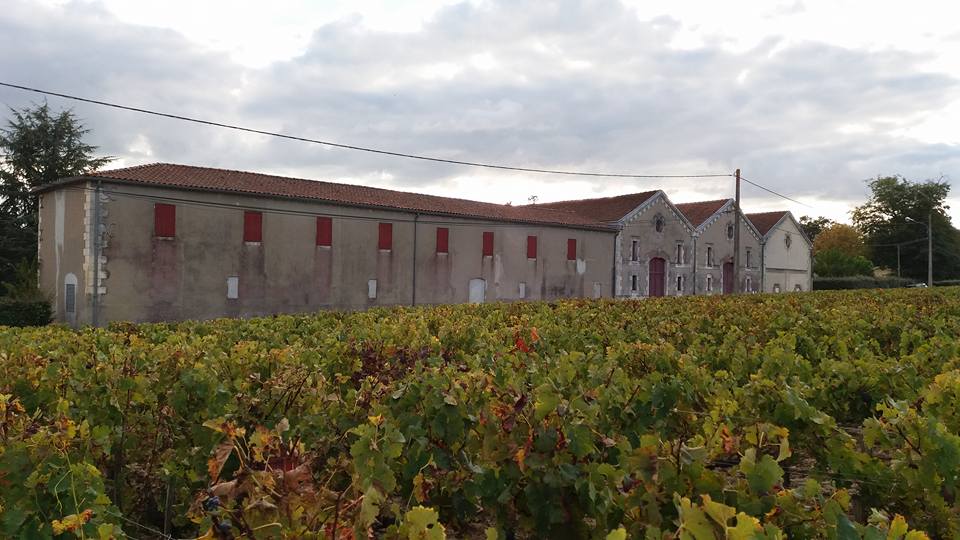
The view from my bedroom window looking out across the vineyard. The winery and cellars can be seen in the background.

Directions outside the winery. Ch Labat is a smallish 7ha plot also owned by the Nony Family, effectively the second wine of Caronne


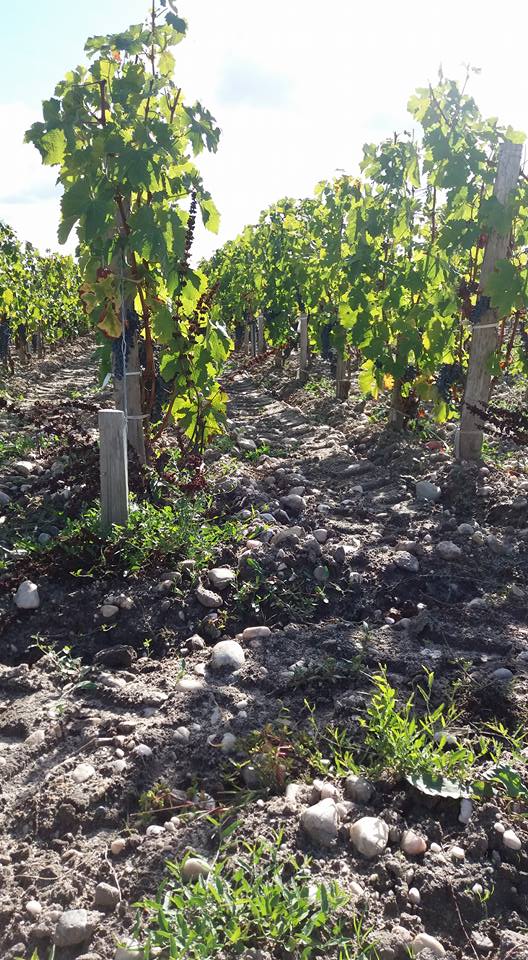
The first and second days were spent in the vineyard itself, of which Caronne comprises 45 hectares planted to 60% Cabernet Sauvignon, 37% Merlot and 3% Petit Verdot. The Cru Bourgeois-rated estate (a labelling term granted to the best Médoc châteaux who were overlooked in the 1855 Classification) possesses an enviable location, on the borders of the St-Julien appellation and flanked by the classed growths of Gruaud-Larose and Lagrange. As such, Caronne shares the same gravelly soils which are so suited to growing high-quality Cabernet, as well as sandier, clay-based soils ideal for Merlot. Stepping out into the crisp morning air, armed only with a pair of gloves, a small basket and secateurs, I joined my fellow vendangeurs and began collecting the fruit. We worked row by row, vine by vine, occasionally stopping to pour the grapes into the larger bucket on the back of one of my colleagues. The difference between manual and machine harvesting is much discussed, and I'm a firm believer in the former raising the quality of the finished wine. Certainly, we were able to discriminate much better between the ripe grapes and the rotten ones, which the machine harvesters working on different vineyard plots were unable to do. Despite the strenuous nature of labouring among the vines, I cherished every second of the work as it really brought home the importance of good base material to the finished product. Without respect for proper viticultural practices (i.e. correct trellising, leaf stripping etc.) and respect for terroir (i.e. which grapes grow best on which soils), there would be little point in expecting a successful end result. More and more Bordelais wine producers now understand that the quality of the wine comes primarily from the vineyard, not the winery, and I think this is certainly evident in the quality of Caronne's finished wine.


Gravelly soils for Cabernet...
...and sandy soils for Merlot


My fellow vendangeurs at Caronne

Towards the middle of the week, I hung up my secateurs and went to work in the winery itself. Château Caronne was one of the last estates in the Médoc to harvest in 2016 (the threat of rains and rot virtually non-existent), but the forecast had begun to turn and so more machine harvesters were sent out to the vines, whereas the manpower was concentrated in the winery. To my mild surprise, operations in the winery were headed up by 24 year old maître de chai Henri, assisted by his equally young colleague Alex. Henri and Alex were in charge of everything from the moment the grapes arrived on the sorting table to the final fermentation. Both worked with an incredible mix of whirlwind energy and cool-headedness which showed a maturity far beyond their years. For someone like myself who had no prior experience of working in a winery (manual labour and retailing I can do; scientist I ain't!) I was initially very daunted at the sight of enormous industrial steel vats, an array of interconnected piping and hoses, and noisy equipment and machinery which I hadn't the foggiest as to their purpose. Fortunately for me, also staying at the Château was an American guy called Mike, who had arrived a week prior to me. Because the harvest had been delayed, Mike had spent most of his time shadowing Henri and Alex, and was therefore able to show me the basics of what was going on. Wearing ear defenders and communicating in a mix of hand gestures and broken French, I spent my time scrambling around the vast winery, doing basic tasks like monitoring sugar levels in fermenting juice, mixing yeast and tannin solutions to be poured into the vats and helping to sort the grapes as they arrived on the tractors. Although at the time I felt frantic and slightly useless, in retrospect I think I learnt an awful lot and was exposed to machinery and processes which I'd never known existed. It was also beneficial for me to appreciate the 'intermediary' stage of winemaking: I had good knowledge of processes in the vineyard and, of course, am enamoured with the finished article, but I'd never really given much thought to the place of the winery and its role as the engine room of winemaking. Despite having preferred the relative sanctuary of the vineyard, I certainly don't regret having had the opportunity to experience the other side of the winemaking coin.
 
The winery at Ch Caronne Ste Gemme
Grapes arriving into the winery, where they are subsequently sorted (below)


Henri, Alex and Mike tending to one of the fermentation vats

Not a bad place for a coffee break!


On the last full day, Friday, before my departure the following morning, myself and Mike were allowed a day off to explore the region and visit the city of Bordeaux itself. Bordeaux is an historic port city on the banks of the Garonne River - a fact not insignificant to the success of the region's wines. We spent the morning wandering around the city centre, taking in the sights and doing vaguely touristy things. For lunch, we travelled across the city to St-Emilion and to the Grand Cru Classé estate at Château La Dominique. We enjoyed a three course lunch at the restaurant overlooking the vineyards - La Terrasse Rouge - as well as knocking back a few glasses of their second wine, Relais de la Dominque. On the drive back to Caronne, we toured around some more of the Médoc estates, and even managed to blag a little tasting at Château Pontet-Canet, a Pauillac Fifth Growth and one of the few Bordeaux châteaux to have fully embraced biodynamics. The estate's 2008, whilst young, will remain in my mind as one of the best wines I've tried for many years to come.


View from La Terrasse Rouge at Ch La Dominique

When Saturday morning came, I felt a mixture of regret at having to leave Château Caronne, but also a great satisfaction in knowing that I'd had the opportunity to visit the estate at such an important moment in the year. I felt the uniqueness of my experience too: each vintage in Bordeaux is inimitable, and the wine that is produced at Caronne next year will be different to the one that I had the pleasure to share in. After loading the car, I bade my farewells to the family, Mike, Henri, Alex and everyone who I'd met during the week. François very generously offered me a bottle from his cellar, so my magnum of Caronne 2012 is now under lock and key until an appropriately special moment in my future. I drove down the estate's pebbled road, turned back one last time to look at the Château, then headed towards the airport. Au revoir Bordeaux! I will miss your charms, your beauty and your idiosyncrasies, but at least I will have the pleasure of drinking your varied and delightful offerings until my next visit.

My generous hosts, Francois and Georges Nony, at dinner


Goodnight Caronne!


--------------------------------------------------------------------------------

N.B. Over the course of the week, I had the opportunity to try many vintages of Caronne Ste Gemme, including several dating back a couple of decades. As with other top quality red Bordeaux, there is pleasure to be had in drinking Caronne at all stages of its life, from infnacy right through to old age. The current vintage of the estate's wine available in the UK is the 2011. Below are some of my notes on the 2011, which is a great example for anyone looking to understand Cru Bourgeois-level Claret. Enjoy!

The 2011 has a deep ruby (still opaque) colour, with an intense nose of blackcurrant, cedar and smoke. With aeration, notes of Oriental spice emerge (jasmine?). The palate is nicely austere, with reassuringly classic Médoc flavours of blackcurrant and pencil lead. The Cabernet is evident in the blend. The wines finishes long and linear, with tannins that are just beginning to show signs of drying. Drink until 2022 with roast beef or similarly hearty fare. 

Wednesday, 21 September 2016

Moët & Chandon Grand Vintage 2008 Launch

Last week, I was delighted to accept an invitation to attend the launch of Moët & Chandon's Grand Vintage 2008 Champagne. I travelled down to London with a number of my colleagues to the Moët Hennessy UK headquarters in Belgravia, full of optimism and great expectation. I've previously written about my love of two of Moët's other Grand Vintage incarnations, the beautifully poised 2006 and the warming, generous 2002, so I was very much looking forward to tasting and assessing the House's 2008.

On arrival, we were greeted with a generous measure of Moët Brut Impérial NV, accompanied by a selection of mouthwatering hors d'oeuvres (who would turn down a delicious quail's egg and salmon blini at 10am?). We were introduced to the International Brand Ambassador for Moët & Chandon, Justine Proy, and invited into the tasting room for the main event. As well as tasting the Grand Vintage 2008 Brut and Rosé, we were fortunate enough to sample two back vintages in Moët's 'Grand Vintage Collection': their 1998 and 1988. Below are my tasting notes for the four wines sampled, as well as some interesting tit-bits as regards production and aging.


My colleague Natalie and I enjoying a breakfast tipple!

Moët & Chandon Grand Vintage Brut 2008

Whereas most non-vintage Champagne cuvées are the embodiment of a fairly rigid house style, vintage offerings allow the Chef de Cave a little more room for manoeuvre. This certainly holds true for Moët, whose vintage Champagnes are based on three essentials: "freedom of interpretation; selection of the year's most remarkable wines and individuality of the vintage". For 2008, this means creating a wine which reflects the high acidities of a cooler vintage, yet also allowing the relatively good levels of ripeness to shine through. On the nose, the 2008 displays delicate aromas of lemon and flower, supported by a dainty yet present note of bready yeast. On initial tasting, the palate is fresh and vivacious, which subsequently mellows on the mid-palate to warmer citrus, greengage and almond. The finish is zingy and lingering, revealing a Champagne which - while still currently tight and coiled - will age effortlessly.

Moët & Chandon Grand Vintage Rosé 2008

It still surprises many people to hear that the only wine region in Europe where red and white wines can legally be blended and sold as rosé is in Champagne. In fact, this is crucial for a house like Moët, whose 2008 Rosé is comprised of almost half Pinot Noir, of which 20% starts life as red wine. The reasoning behind this is to impart enough tannins into the finished wine so as to balance out the high acidity (2.98 pH) and the dosage (5g/litre), to culminate in an harmonious Champagne. On evidence, Moët has achieved this with its 2008 Rosé. A deep, rose petal pink in glass, the 2008 displays a nose with nuances of red berry fruit and spice. The mouthfeel is fuller than its Brut sibling, with the acidity being masked by the wine's levels of tannin. Delicate, mature fruits of strawberries and blackcurrants are displayed on the palate, in what is a precise and linear rosé cuvée.


Brand Ambassador Justine Proy in full flow

Moët & Chandon Grand Vintage Collection Brut 1998

Like all good Champagne producers, Moët keeps a considerable amount of wines back in its cellars, either to use as future blending wines or, as is the case with its 'Grand Vintage Collection', to release as single vintage finished articles. We were invited to taste the 1998 as, according to Justine, the year was a very similar vintage in terms of climatic style to 2008, so tasting the '98 would allow us a potential glimpse into the future of the new release. On evidence, this bodes extremely well. Notably darker in glass yet without a trace of dullness, the '98 displays a developing, caramelised nose with notes of dessert apple, almond and toffee. The high acidity of the vintage translates into a Champagne that remains fresh and precise, yet with a comforting, generous nature, thanks to the extended 15 year period of lees aging.

Moët & Chandon Grand Vintage Collection Brut 1988

Personally, I'd never had the opportunity to try such a mature Champagne as the 1988 Moët, and I'm sure this held true for many of my colleagues. Like the '98, the 1988 vintage was again marked by high acidities with just enough fruit ripeness to satisfy the winemaking team. This didn't stop them, however, upping the dosage to 7.5g sugar/litre (compared with 5g/litre in the Brut 2008) in order to achieve balance. For me, the 1988 Brut proved my favourite of the four offerings: I can't recall ever trying a Champagne which caused such intrigue and delight. A deep, golden hue in glass, the nose is full of developed, tertiary characteristics: namely honey, salinity and iodine. The palate offers an appealing plushness whilst remaining light in the Moët style, and displays dried apricot and richer fruits alongside the tertiary notes of nuts and umami savouriness. Here, the acidity is fully integrated into the wine's structure; the supporting cast to the crescendo of flavours rather than the conductor. Overall, it truly was a wine that bowled me over. The only problem? Being such an esoteric and complex Champagne, I struggle to think of an occasion when the Moët 1988 wouldn't entirely overshadow the main event! Although, perhaps therein lies the answer...


A stellar line-up

Sunday, 4 September 2016

Brothers in arms

Fresh from my gin-drinking escapades in the North of England, I figured it was best to return to my comfort zone and re-acquaint myself with tasting and reviewing some top wines. My experience at The Lakes Distillery did focus my attentions, however, on the concept of terroir and the natural environment, which is just as important to grape growers and winemakers as it is for the dedicated distilling folk up in Cumbria. For me, one of the best things about any drink is its loyalty to its provenance; whether that be capturing the river water from the Derwent to use for Cumbrian spirit distillation, or winemakers in the South of England making use of their Champagne-esque soils and grape varieties to produce some world class sparklers. To misquote the motto of a famous Catalan football club, wine is more than a drink: it's an enchanting, beguiling liquid which, at its best, speaks of its environment, its origins and the roots and heritage of its makers. In short, any great wine should speak of its terroir, or the fundamental geographical and viticultural aspects that mean the liquid can only have been produced in that specific place.

Yet it's not just the land and environment that count: great wine can only be made with the input of great winemakers. Wine is a substance that brings friends and families closer together, and no-one is able to understand this more than winemaking families themselves. This is exactly the set-up at Giesen, where three winemaking brothers ply their trade. Born and raised in Germany, Theo, Alex and Marcel founded their winery in 1981 in the Dillon's Point area of Marlborough, with their first vintage produced three years later. Today, Giesen wines are exported to over 30 countries around the world, and their wines are some of the best to hail from New Zealand. Around six months ago, I purchased a couple of bottles from Giesen's 'The Brothers' selection, which is a range of wines blended from the best parcels in each vintage to showcase the pinnacle of the grape and the region. The label is also an homage to the Giesen brothers and their original pioneering spirit. Below are the tasting notes for both wines sampled from the range, the 2012 Pinot Noir and the 2013 Sauvignon Blanc.


Giesen 'The Brothers' Sauvignon Blanc 2013, Marlborough


From a vintage called "outstanding [...] with near-perfect conditions for growing grapes" (according to New Zealand Winegrowers CEO Philip Gregan), the 2013 Giesen Brothers Sauvignon is certainly a blockbuster of a wine. A small proportion of the Sauvignon grapes for this cuvée are fermented in old French oak, which imparts complexity and ageability to the time-honoured Marlborough style. A pale, lemony-green colour in glass, the wine is intensely aromatic with a core of green pepper, nettle, gooseberry and tomato leaf. More citrus notes like grapefruit and lemon juice emanate from the glass with persistence. On the palate, the wine is light-bodied, although with a decent mid-palate weight. Despite its relatively seniority (for Sauvignons age much quicker than the rest of us) the Brothers Sauvignon remains searingly fresh and zippy. The flavours in the mouth are dominated by more underripe, citrus notes (gooseberry, grapefruit, lemon) which truly are monstrous in intensity. The finish is heroic, and lasts for well over a minute, underpinned by a bassline of sparkling minerality.

A fabulous wine, the Giesen Brothers Sauvignon Blanc certainly ranks right up there with the best of its kind from Marlborough that I've sampled. It finds favour among the critics too: Bob 'Mr New Zealand Wine' Campbell MW scored it an excellent 93 points. Although it would be fascinating to cellar it for a year or two to see how it develops, the Brothers Sauvignon is highly enjoyable to drink now, especially when paired with creamy goats cheese dishes.


Goat's cheese and red pesto tartlet


Giesen 'The Brothers' Pinot Noir 2012, Marlborough


As with its successor, 2012 was also a vintage of note in New Zealand, with Decanter magazine deeming it to be "consistently very good everywhere". Marlborough fared very well, and this comes across in Giesen's delicious, ageworthy Pinot Noir. To look at, the wine appears much older than its years: much of the ruby colour now having faded to a pale garnet hue. On the nose, The Brothers Pinot is initially mild-mannered, yet gradually yields its aromas of dusky cherry and blackcurrant, fresh cranberry, black pepper and earth. Like all good Pinot Noir, the aromas of The Brothers wine have a slightly reticent, other-worldly quality, which requires patience on the drinker's part before the full array of flavours are revealed. In the mouth, the wine has a good weight of palate, with stalky tannins and mellowing acidity. Again, the flavours present aren't shouty, but beautiful notes of cranberry, redcurrant and savoury spice do gradually caress the tongue. The wine finishes well, leaving an overall impression of smoothness. This is a 14% New World red, but certainly doesn't feel overly-alcoholic or cumbersome.

Like its counterpart Sauvignon reviewed above, The Brothers Pinot also scored well with a number of critics, most notably receiving points 93 from the former Wine Spectator critic James Suckling. I'm not sure I would have been quite as generous in Suckling's position, although I readily admit I'm still a relative novice when it comes to exploring the many mysteries of Pinot Noir. Certainly, it is a very well-crafted wine, with a specific character that doesn't feature in Burgundy yet appears in many Pinots from across New Zealand. I have no doubt that it would age comfortably and develop a spectrum of tertiary flavours, although I very much enjoyed drinking it presently with a hearty pork and onion casserole.


Rustic pork and onion casserole

In summary, both the Sauvignon Blanc and Pinot Noir from Giesen's 'The Brothers' range were excellent wines, both of which were made with respect for the grape and terroir at the forefront. Despite New Zealand's relative infancy as a force in the wine world, wines like the two reviewed show the suitability of the country for growing classic cool climate varieties, arguably - in the case of Sauvignon Blanc - more successfully so than its Old World counterpart (I still think that, despite the ridiculously high inflation of prices, nowhere does Pinot Noir quite like Burgundy). Nevertheless, the successes of the Giesen brothers certainly show the value of respect for the natural environment coupled with winemaking prowess. As a partnership, these two aspects truly are the driving force in producing great wine.


Wednesday, 17 August 2016

From Cumbria with love

Recently, as part of a tie-up between my employer and The Lakes Distillery, I was very kindly invited to spend the weekend up in Cumbria visiting the aforementioned producers, to indulge in a spot of - ahem - thorough research. Myself and Mrs TomOnWine were to stay in an idyllic riverside hotel on the banks of the River Derwent, from where we would spend time exploring the distillery and its highly-rated restaurant, as well as taking in some of the beautiful Cumbrian scenery. There are very few things that cause Mrs TomOnWine to awaken early on a Saturday morning, but with the prospect of free gin tasting in the offing, we began our journey up to the northernmost tip of England's largest National Park.

Looking east across Bassenthwaite Lake

Arriving in the Lake District, we were taken to our accommodation for the weekend - the luxurious and welcoming Trout Hotel in the small town of Cockermouth (www.trouthotel.co.uk). The hotel, which was awarded 4 stars by The AA and Visit Britain in 2009, sits on the banks of the River Derwent - the same river that provides the water for spirit production at The Lakes Distillery. After checking in, we took the short ten minute car ride to visit the main attraction (www.lakesdistillery.com). Situated at the north-western point of Lake Bassenthwaite, the distillery itself is a bijou enterprise, comprising of a few small constructs renovated from farm buildings dating back to the Victorian times. Aside from the modern bistro and visitor gift shop, of primary interest was the structure which housed the distillery itself, where the whiskies, gins and vodkas are lovingly crafted and matured.


Led by our knowledgeable and amiable tour guide Mike, we were taken inside the heart of the distillery and given a fascinating glimpse into the production methods of top quality spirits. As previously mentioned, the majestic River Derwent is the source of the distillery's water supplies, and it was emphasised by Mike how proud the company is of showcasing one of Cumbria's most important assets in their products, as well as the quality and purity that the river water brings to the final spirit. We were shown the copper stills and other equipment used in the production of The Lakes' spirits, and even allowed to set foot inside their bonded warehouse, where various incarnations of their whiskies sat maturing in an impressive array of oak barrels, including those used in the production of Bourbon and Sherry. Unfortunately I was unable to capture much of this on camera: partially due to secrecy, however mainly to do with my distraction and delight at being surrounded by such glorious and intoxicating sights and smells.

Mike in full flow

Following the distillery tour, we were invited into the tasting room where we sampled three of the Lakes Distillery's current commercially-available offerings: The Lakes Gin, Vodka and Blended Whisky. Below are my brief tasting notes on the trio:

-While the company waits for its Holy Grail and flagship single malt to mature, The One Whisky isn't a bad substitute to fill the void. A reference to the blend of whiskies from across the United Kingdom's four nations, The One Whisky is a clean and linear spirit, with attractive smoky notes. Its peaty character betrays its provenance: over 70% of the blend is made from high quality single malts.
-Probably the distillery's most popular product, The Lakes Gin offers all the character required to satisfy the modern gin drinker's palate. Fresh, fragrant and pure, the gin is dominated by citrus peel, juniper and dried herbs, and requires but a splash of tonic to showcase its full potential.
-With vodka fast becoming a retro choice, The Lakes Vodka reminds us how good the spirit can be if afforded the necessary care and attention. Ghostly in its purity and silky smooth from extended copper contact, the vodka can be enjoyed neat, on the rocks or as an excellent base for a Vesper cocktail.

The Lakes Gin, Whisky & Vodka

Tasting Room

Hard at work

After an arduous tasting session, our appetites were fully whetted to enjoy the offerings of The Lakes' restaurant - stylised as 'Bistro at the Distillery'. The menus are contemporary British, with some real stand out gems available (the Farmhouse Cheese and Spinach Soufflé being highly recommendable; so too the rib-eye steak). Equally pleasing is the impressive wine list, which is varied and reasonably priced. Those which caught my eye included England's premier sparkling wine Nyetimber (available by the glass and bottle), and back vintages of a pair of well-regarded Left Bank Clarets - Châteaux Batailley and Léoville-Barton. All of the distillery's own offerings are, of course, available too.

The desserts and cocktails weren't too shabby either

It is always with a tinge of sadness that one returns from a relaxing getaway back to the daily grind, and our trip to Cumbria was no different. Both myself and Mrs TomOnWine experienced a thoroughly enjoyable time in the beautiful Cumbrian countryside: a part of the world that we hadn't previously visited, but one to which we would return in an instant. It was also fantastic to catch a glimpse into the exciting world of spirit production at The Lakes Distillery, and I'm sure that their business will continue to flourish. Certainly from the reaction I gauged from fellow visitors, as well as the general trend of increasing popularity of local artisan produce in the UK, there is no reason why the company shouldn't become an institution in itself. It was certainly refreshing to see a dedicated group of people craft produce that both utilises and is reflective of the natural resources in their environment. Perhaps new British winemakers should take note: instead of fighting against the weather and orthodox consumer tastes, might it not be better to craft products which are more faithful to our natural climate and geology, as The Lakes have done with their spirits? Without a doubt, the good folks at The Lakes Distillery are ascending rapidly up the path to enduring success. If only my patience in waiting for the release of their single malt was as determined...